“During a time of physical-distancing, what can we do to promote meaningful and productive civic engagement?”
Introduction
Background
Hackathon: Democracy Design Jam, May 16-17, 2020 (Previously named WeVote App)
School: University of Washington, Seattle
Program: M.S. Human Centered Design & Engineering
Post-Hackathon: 1st Place Winner, sponsored by League of Women Voters; Merged with political fundraising start-up, GiveBlue (2020- present)
My Roles
Designer, ML Researcher, Frontend Developer
Constraints
Time: Created over the course of a weekend with 16 building hours
Social Distancing: Teams were working remotely during pandemic lockdown
THE PROBLEM SPACE
UW’s HCDE department hosted a hackathon to explore civic engagement during the pandemic.
Teams were given the following prompt:
Under normal circumstances, 2020 would already be a major election year in the United States. Now, the Covid-19 pandemic is creating even greater pressure, having already caused disruptions in the election cycle. With just under six months until the November general election—and no clear end in sight for physical distancing—the clock is ticking to figure out how best to leverage social and communications technologies to engage in healthy democratic practices from afar.
Design Question:
During a time of physical-distancing, what can we do to promote meaningful and productive civic engagement?
Process
Brainstorming
Having never worked as a team before, we started with a brainstorming session on Miro Board. This allowed for team bonding, sharing our understanding of the design prompt, and address any assumptions or biases. We learned that we all came from different states, some of us from swing states. This insight reminded us how different the voting process can be state-to-state, for example, mail-in ballots only, voting booths, and early voting. This helped us scope our project in wanting our solution to potentially bridge multiple states and remain non-partisan.
Research
Methodologies
User Interviews
Competitive Analysis
Expert Interviews
Key Takeaways
After formulating the design question, the in-depth research phase began. Due to time constraints three main methodologies were pursued: Competitive Analysis, Expert Interviews, and User Interviews.
We interviewed voters from across the United States. This helped us to understand different voting processes for each state. Voters were overwhelmed with the amount of information shared on political candidates without confidence on information accuracy and transparency. Additionally, voters wanted a way to be more engaged in the political process and interact with candidates that were closely aligned with their political beliefs.
Through competitive analysis across candidate and grassroots campaigns, we found several partisan initiatives. From the non-partisan perspective, there were many programs aimed at “getting-out-the vote” through social media campaigns, access to voter pamphlets such as League of Women Voter’s VOTE411, and candidate profiles from Ballotpedia.
The hackathon also allowed gave us access to industry experts in civic tech, dis/mis-information, politics, law, design, and engineering. We took advantage of these resources through participating in lectures and office hours to discuss many points in our research and design journey.
Through our research we concluded our solution should address voter needs through education, information transparency, and engagement.
Core Users
Based on user research the following represented our core users:
the novice
Who They Are
Political novice who feels intimidated by politics
What They Want
Learn more about politics, enter politics
the busy constituent
Who They Are
Has a lot of commitments in their life where politics is not there first priority
What They Want
Knowledgeably fulfill civic duty
The passion voter
Who They Are
Passionate about their political beliefs, driven by social causes
What They Want
Discover and engage with candidates that match their views and transform the political landscape
Ideation
After completing our research phase of understanding different types of voters across America, we began ideation through remote collaboration on a Miro Board. We split the board into different themes to aid in creating an affinity diagram to map user needs to address this complex design question. This mapping helped us to identify the following tenets we wanted to exemplify through our design solution. Due to social distancing with the pandemic, all of these would be best served by creating a mobile application.
Main Tenets:
transparency
Due to polarization of political landscape, voters wanted confidence in their sources. We found users preferring non-partisan platforms that could fact-check their content and resources.
education
Many felt intimidated by politics and wanted a platform to help them step-by-step along their research journey.
engagement
Voters wanted a way to engage with candidates, whether through in-person or virtually through town halls, office hours, or campaign events.
Mapping the User Workflow
Speaking with voters across America during the global pandemic led us to create a holistic mobile application.
Before starting to prototype in Figma, we mapped out the user flow for the features we had in mind. Due the the fast-paced nature of the hackathon, we knew we’d be simultaneously creating screens.
Prototyping
Figma was used to wireframe, iterate, and prototype due to its ability for real-time collaboration. Even with the time-crunch, a mid-fidelity prototype was made to aid in quick decisions with users and experts in the field of what to scrap, iterate, or keep. We made boxes for each section - onboarding, topic list, candidate list, and candidate profile - to keep us organized as we prototyped.
Usability Study
As part of the hackathon we only had time to do brief usability studies with voters.
Key Findings & Refinement
As a team who are progressive leaning, these usability studies helped us to ensure that our design was remaining non-partisan, even through color choice for the style guide
We were concerned that our app would only cater to novice users, but our proposed solution was found to be helpful by all of the types of voters we identified in our personas
Added an additional screen to give topics a rating
Final Product
Style Guide
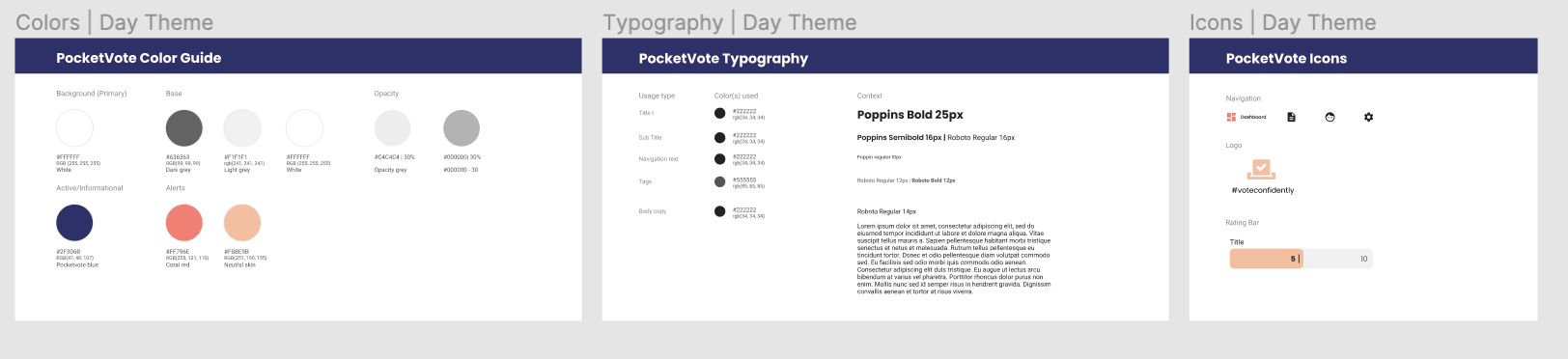
To remain non-partisan, our color scheme included purples and mix of non-partisan colors. Creating this style guide with components also helped our team who was creating screens simultaneously stay consistent.
On-boarding
Onboarding page that starts with user’s general location and learn which topics matter most to compile a list of candidates and initiatives that matter most to the user.
Rationale:
The onboarding was key to filter candidates from particular cities and states. We wanted it to be private enough that specific addresses did not need to be entered. Picking the topics that mattered most to users allowed gave them an opportunity to understand topics that were most important to them without looking at candidates based on party lines. There was also an education tool built in to explain each term and to select if a topic was neutral.
Candidate Matching & Engagement
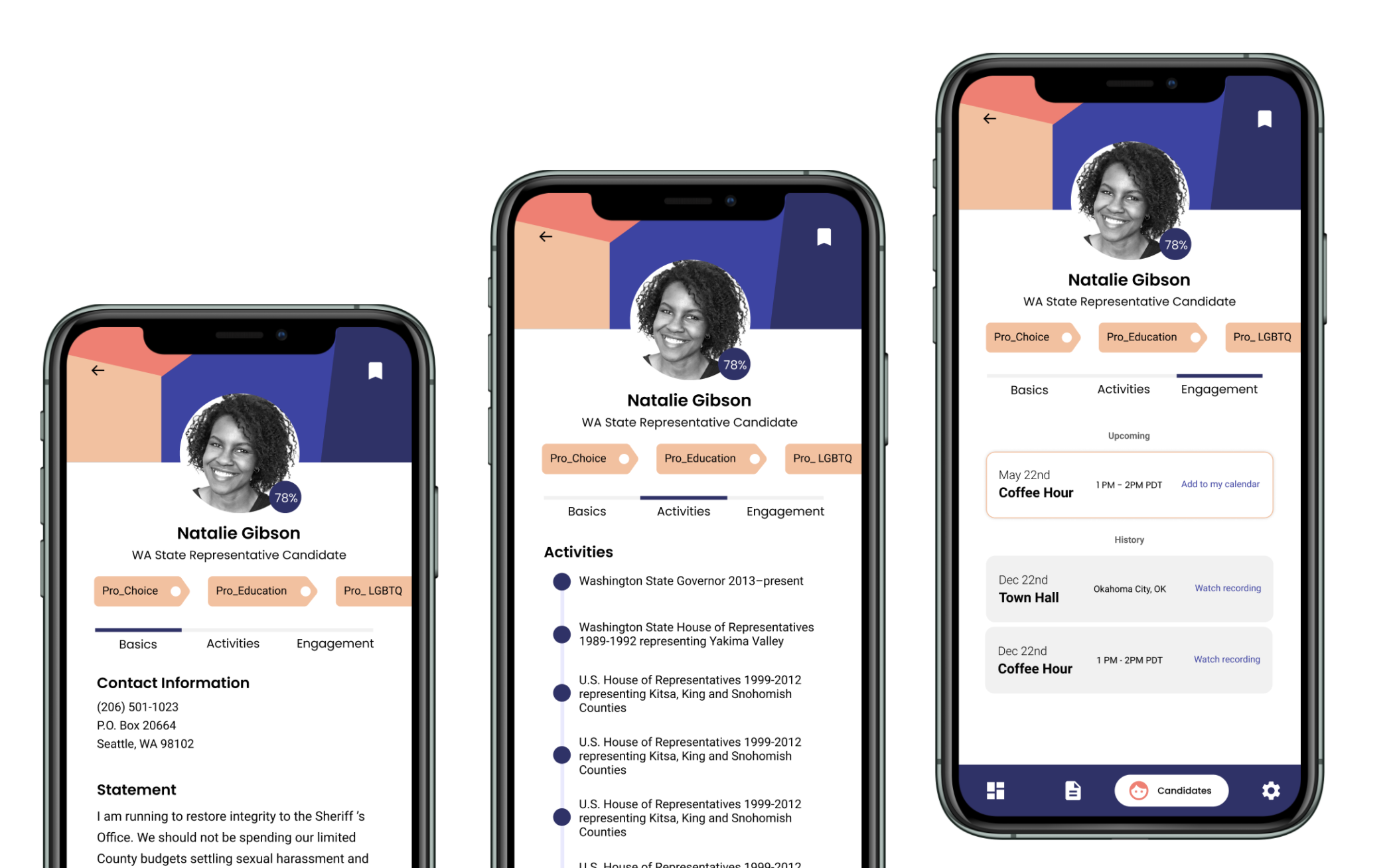
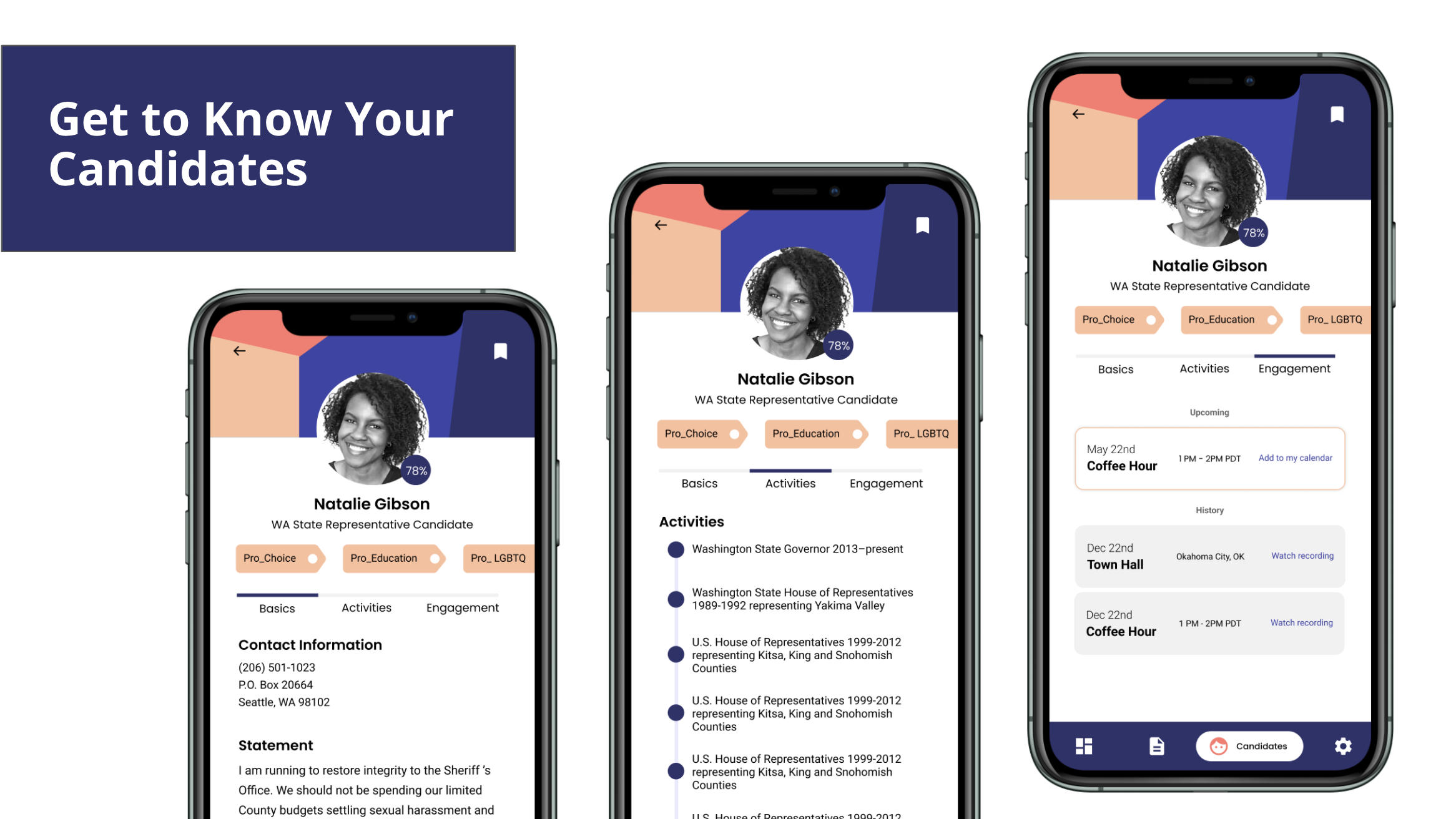
We created an outline to an algorithm that would match voters to candidates that aligned with their values during the onboarding process. From there, users could read more about each candidate, learn about their background, and even join activities to engage with candidates through online coffee hours or town halls.
Rationale:
It was crucial for users to have tags explaining why a particular candidate was matched with the user. Additionally, voters wanted more opportunities to interact with candidates and the Engagement page allows for transparency for upcoming events so that voters can make the best decisions for themselves.
Moving Forward
Reflection
Our team learned valuable lessons from a weekend hackathon:
Understanding core users helped to keep our ideation process focused under a tight timeline
Open communication was key in a remote environment and we found new tools to aid with remote collaboration
Taking time to meet with experts in the civic tech field gave us additional insights into our design
Future Work
We had the opportunity to continue our work with the League of Women Voters and GiveBlue. Below is what we were able to complete post-hackathon including future endeavors:
Completed additional usability studies and iterations
Developed front-end of PocketVote
Merged product with GiveBlue, to add a fundraising feature
Product estimated to be launched Fall 2021