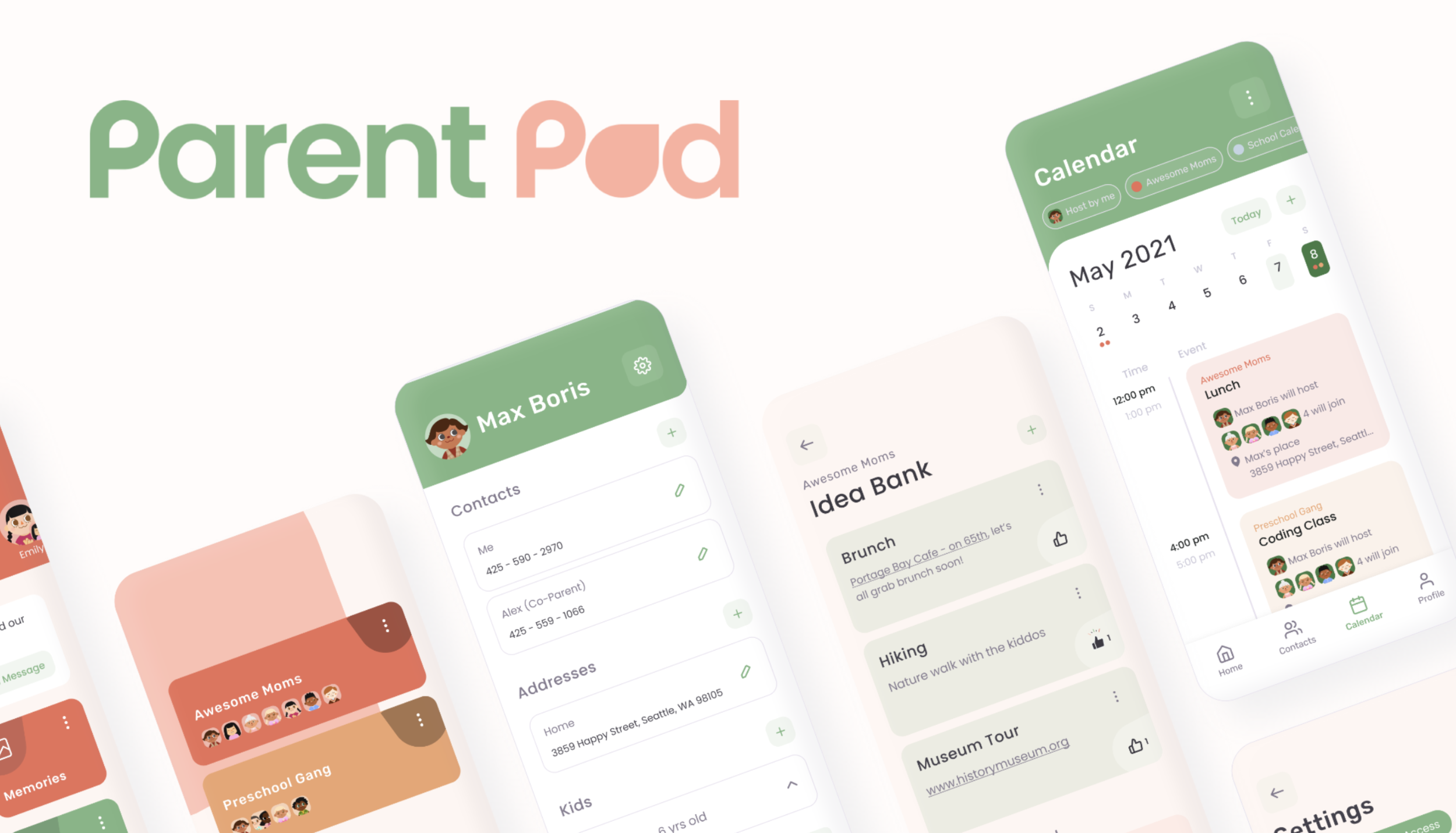
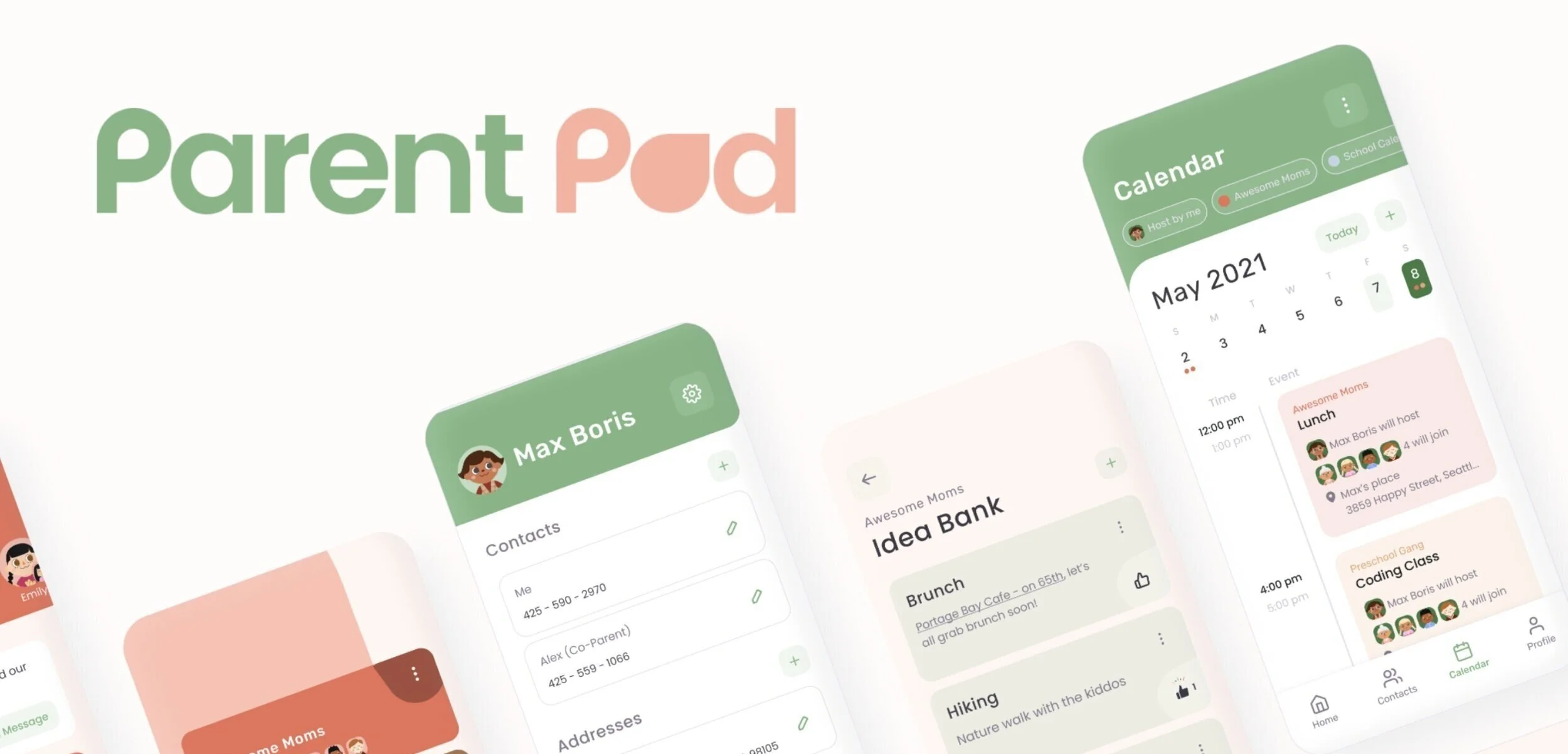
“How might we lower the barrier to community-based parenting?”
Above: ParentPod Product Video
Introduction
Background
Capstone Project: 6 months, Winter/Spring 2021
School: University of Washington, Seattle
Program: M.S. Human Centered Design & Engineering
Sponsor: Gaia Borgia, business woman and single parent looking to begin a start-up around childcare
My Roles
App: Designer, Strategy & Content, Researcher
Video: Producer, Writer, Co-Director
Constraints
Social Distancing: Teams were working remotely during pandemic lockdown
Access to parents & children: Interviews during the pandemic were difficult with parents juggling multiple roles including virtual school and work
THE PROBLEM SPACE
Process
Insights
MetHODOLOGIES & METHODS:
Expert Interviews
Literature Review
Competitive Analysis
User Interviews through Directed Storytelling
Value Sensitive Design (VSD)
Branding & Lean Canvas Workshop
Rapid Iterative Testing & Evaluation (RITE)
Scenario-based Focus Groups
Usability Testing
Key Takeaways
With 6 months and a startup endeavor, we were able to use multiple research techniques from three different stages: Explorative, Generative, and Evaluative. In collaboration with our sponsor with concerns around spontaneous childcare needs and expensive solutions, creating a parental circle, building reciprocal relationships, we determined our overall research question, How might we lower the barrier to community-based parenting?”
The diagram above shows our three research stages. To highlight a few unique concepts for the project:
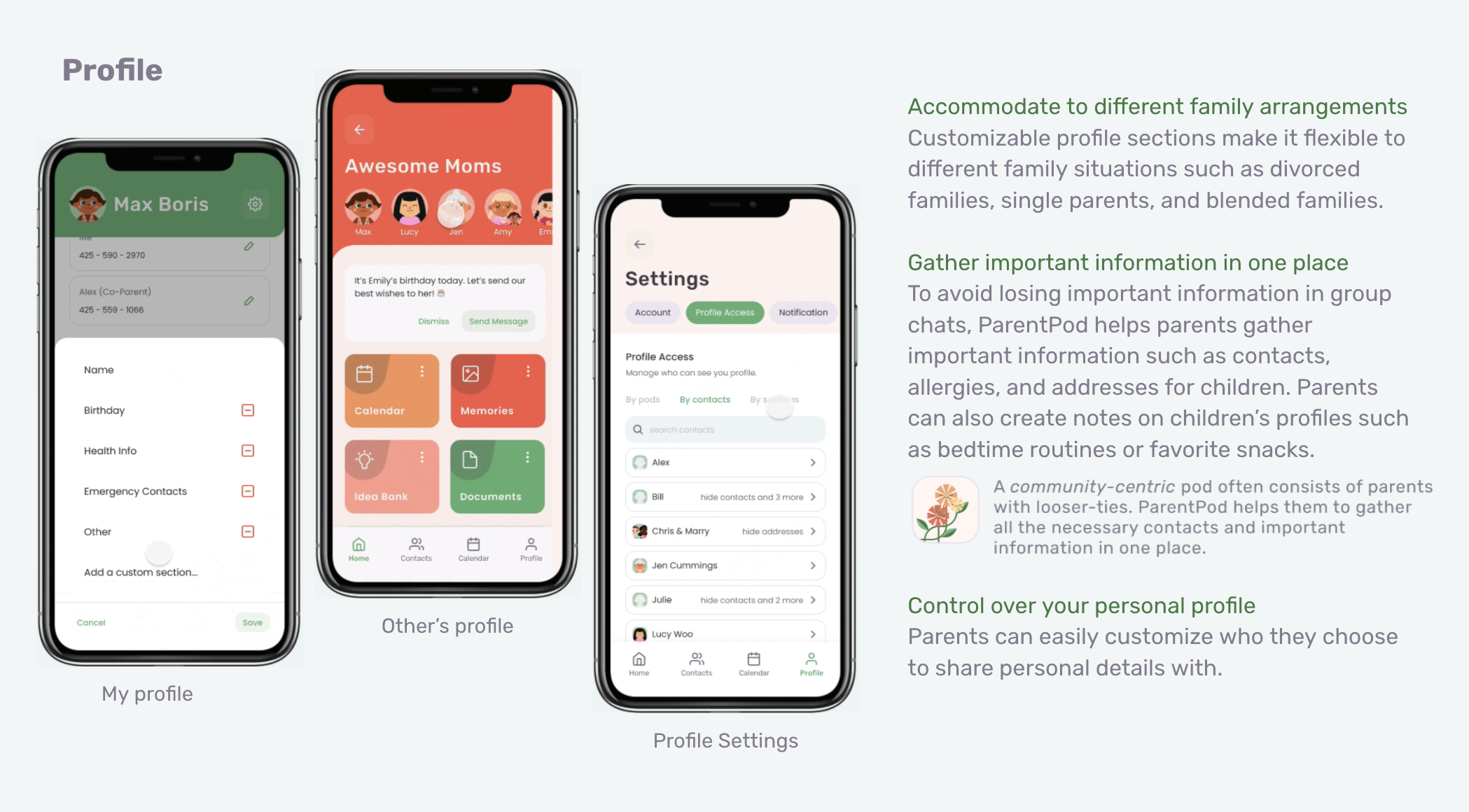
Value Sensitive Design: this concept that advocates for the consideration of human principles when developing technology. Through addressing the values of direct and indirect stakeholders such as parents and children, privacy and safety become important values that can be seen highlighted through ParentPod’s profile settings.
Branding & Lean Canvas Workshop: conducted to help us understand the current market and our solution’s value + competitive edge.
Rapid Iterative Testing & Evaluation RITE: Instead of splitting our work into research for quarter 1 and design for quarter 2, we began sketching ideas early on to evaluate current solutions in the field and inform our design. We used methods such as “crazy 8’s” for design sprints with many of these concepts making it to the final design.
Scenario-based Focus Groups: The scenario-based focus groups with parents allowed parents to simulate a pod experience for us to understand common interactions to incorporate or even leave out of the final design.
Mindsets
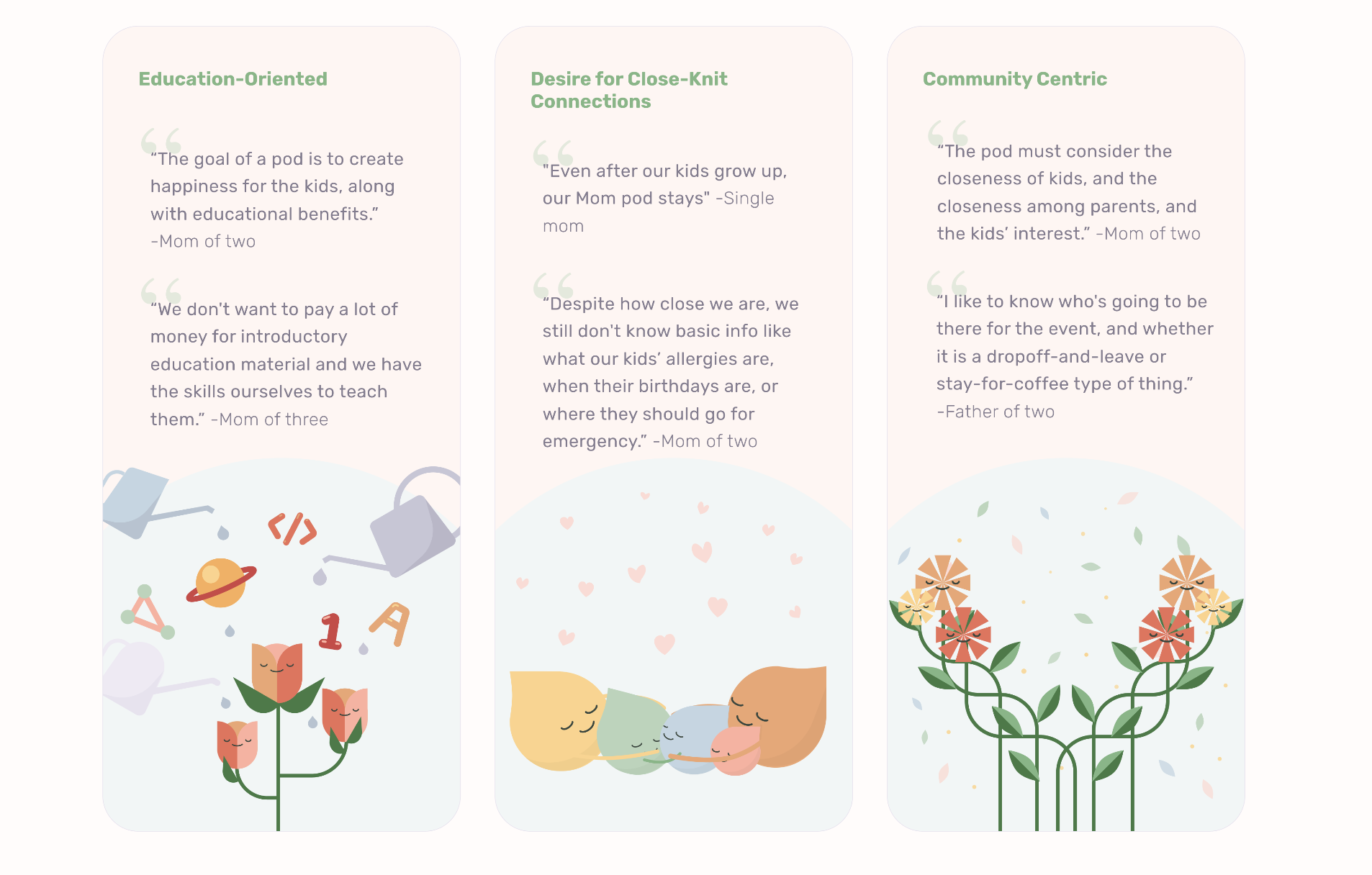
Through our initial round of user interviews, we discovered that parenting goals are dynamic due to various external factors and life stages. In order to capture these dynamic changes, a set of static user personas just won’t cut it.
Therefore, we paid attention to attitudes, behavior, thoughts, ideas, beliefs, and values, and then aggregated those to create 3 primary mindsets to capture parents’ values. These mindsets can overlap or adapt due to changes in a child’s needs and environment as they grow. Additionally, multiple children and contexts can shift these mindsets.
Education-oriented
Who They Are
Passionate about education and parent involvement in studies
What They Want
Pods dedicated to teaching and skill-sharing
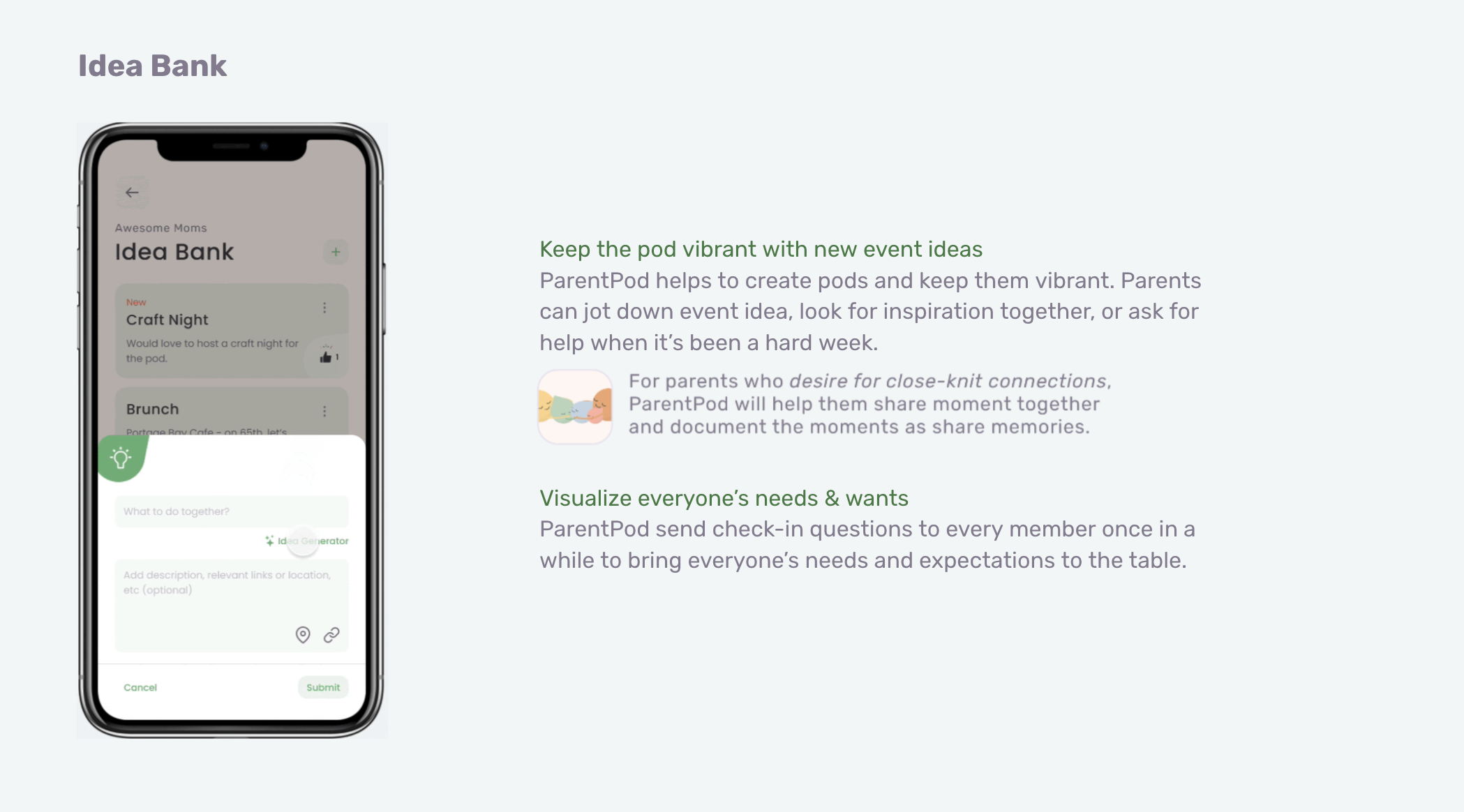
desire for close-knit connections
Who They Are
Families without a large or strong support system i.e. moving to a new area, single parent
What They Want
Friends become extended family who can support each other, especially during childcare emergencies
community-centric
Who They Are
Families within the same community i.e school system, sports practice, neighborhood
What They Want
Support one another with large-scale events and carpools; ease logistics
Usability Study
Since our product depended on a community of users and interactions, it was crucial to get our product in front of parents and their peers.
Key Findings & Refinement
Incorporation of health and emergency information, even with tight-knit groups
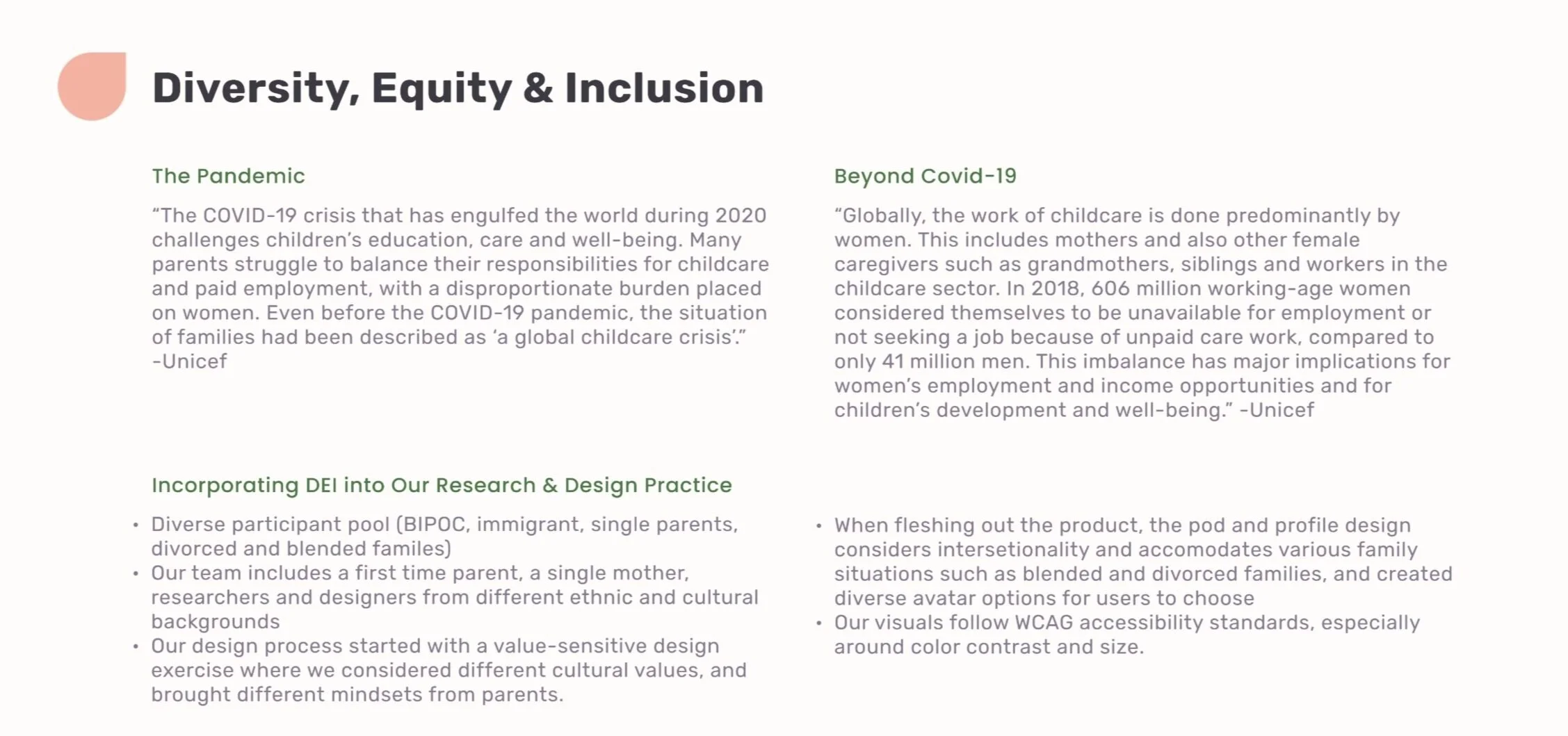
Sharing information about children needed to be customizable based on comfort with co-parents for blended or divorced families
Flexibility of a pod as the children grow up
Final Product & KEy FEATURES
Moving Forward
Reflection & Future Work
Explore novel, edge use cases for our products such as a communication platform between divorced parents.
Conduct larger usability testing to evaluate which design feature should be prioritized for development based on its utility in real-life scenarios.
Build out the onboarding process and design, including sign up, creating a pod, and inviting people. The design should consider how the product can educate the podding concept and also how to guide parents to visualize their different expectations.
Create a development-ready prototype for developer hand-off.
Our sponsor is currently working to find investors to build this app out.